Britain's Geographic Sovereignty Crisis: Why We're Losing the Global Location Intelligence Race

From Maritime Mastery to Digital Drift
In 1714, Britain faced a navigation crisis that threatened its maritime supremacy. Ships regularly foundered on invisible rocks, trade routes remained hazardous mysteries, and the nation's economic future hung on solving the longitude problem. Parliament's response was decisive: the Longitude Act offered £20,000—equivalent to £3 million today—for a practical solution to determine longitude at sea.
That investment transformed Britain into the world's premier maritime power and established Greenwich as the global reference point for navigation. Today, Britain faces an equally critical challenge in the digital realm: fragmented geospatial infrastructure, underfunded mapping authorities, and a lack of coordinated strategy that risks ceding our historical leadership in location intelligence to international rivals.
The parallels are striking. Just as 18th-century Britain needed precise navigation to maintain its competitive edge, 21st-century Britain requires sophisticated location intelligence to thrive in the digital economy. Yet while China invests billions in its BeiDou satellite navigation system and the European Union coordinates massive geospatial infrastructure projects, Britain's approach remains fragmented, underfunded, and strategically incoherent.
The State of Britain's Geospatial Crown Jewels
Ordnance Survey, once the world's gold standard for national mapping, exemplifies Britain's current predicament. Despite maintaining some of the world's most detailed geographic datasets, OS operates under commercial constraints that limit data accessibility and hinder innovation. While European counterparts increasingly adopt open data policies that accelerate economic development, Britain treats its geographic heritage as a revenue stream rather than strategic infrastructure.
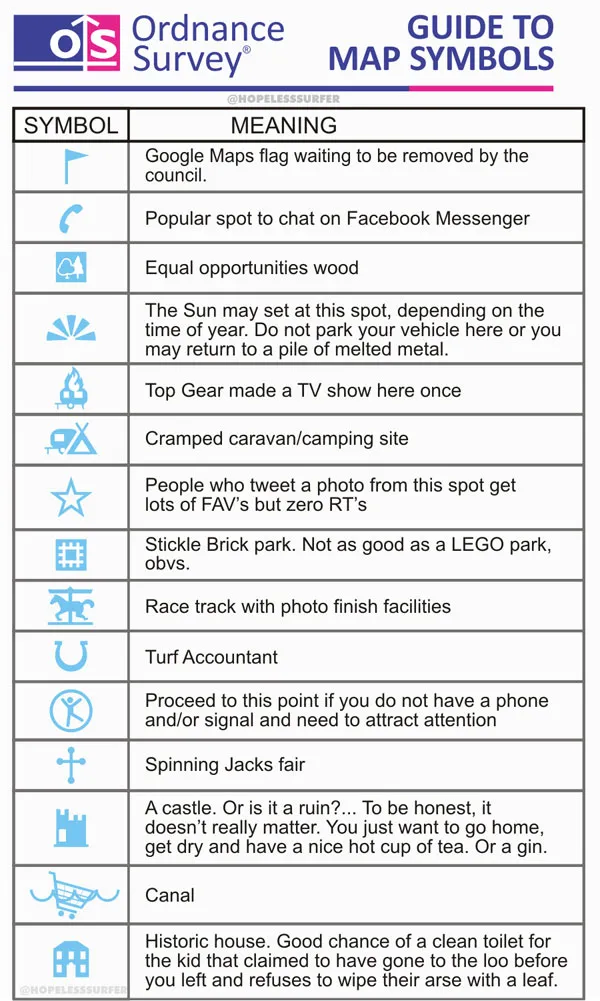 Photo: Ordnance Survey, via cdn.thepoke.com
"We're essentially charging ourselves for access to our own geographic DNA," argues Professor Diana Blackwood, director of the National Geospatial Policy Institute at Oxford. "Every small business that can't afford OS data licenses, every startup that chooses free American alternatives over British datasets, represents a small erosion of our geographic sovereignty."
The consequences extend beyond mere commercial considerations. When British companies increasingly rely on Google Maps, Apple's location services, or other foreign platforms for basic geographic functions, we surrender control over how our own territory is represented, analysed, and understood. This dependency becomes particularly concerning when considering applications in defence, critical infrastructure, and emergency services.
China's Geographic Ambitions: A Wake-Up Call
China's approach to geospatial infrastructure offers a sobering contrast to Britain's fragmented strategy. The BeiDou Navigation Satellite System, completed in 2020, provides China with independent global positioning capabilities while generating detailed location intelligence about users worldwide. Combined with massive domestic mapping initiatives and artificial intelligence applications, China is rapidly establishing itself as a geospatial superpower.
 Photo: BeiDou Navigation Satellite System, via www.sbg-systems.com
"China treats geographic data as strategic infrastructure worthy of state-level investment and coordination," observes Dr. James Patterson, former director of defence geospatial intelligence. "They're not just building better maps—they're creating comprehensive location intelligence capabilities that support everything from urban planning to military operations. Meanwhile, Britain debates whether to charge local councils for access to flood risk data."
The European Union's approach, while less centralised than China's, demonstrates similar strategic thinking. The Copernicus programme provides free, open access to satellite imagery and environmental monitoring data across member states. INSPIRE regulations ensure geographic data interoperability. Galileo offers independent satellite navigation capabilities. Post-Brexit Britain has largely excluded itself from these coordinated efforts, leaving us increasingly isolated in a world where geographic collaboration drives competitive advantage.
The Innovation Deficit: When Geography Limits Growth
Britain's fragmented geospatial approach directly constrains innovation in location-dependent industries. Autonomous vehicle development, precision agriculture, smart city initiatives, and environmental monitoring all depend on high-quality, accessible geographic data. When such data remains locked behind commercial barriers or scattered across incompatible systems, British companies face competitive disadvantages that compound over time.
Consider the drone industry, where Britain once led European development. Regulatory uncertainty around airspace mapping, inconsistent geographic data standards, and limited access to detailed terrain models have driven many companies to relocate operations to countries with more coherent geospatial infrastructure. Similarly, Britain's fintech sector increasingly relies on American location intelligence services for everything from fraud detection to insurance pricing, creating dependencies that could prove strategically problematic.
"We're essentially exporting our geographic intelligence capabilities," warns Sarah Chen, founder of London-based spatial analytics firm MapLogic. "Every time a British company chooses foreign location services over domestic alternatives—not because they're better, but because they're more accessible—we're weakening our own geospatial ecosystem."
Defence Implications: When Maps Become Weapons
The strategic implications extend into national security. Modern warfare increasingly depends on precise geographic intelligence, from targeting systems to logistics coordination. While Britain maintains classified military mapping capabilities, the broader geospatial ecosystem that supports these efforts has weakened considerably.
"Geographic data is the foundation of military effectiveness," explains Colonel (Retired) Michael Harrison, former head of Defence Geographic Centre. "But military capabilities can't exist in isolation—they depend on a robust civilian geospatial infrastructure that provides the technological base, skilled workforce, and innovative capacity needed for strategic advantage. When that civilian base erodes, military capabilities inevitably follow."
Russia's interference with GPS signals and China's territorial claims backed by detailed bathymetric surveys demonstrate how geographic information has become a tool of geopolitical competition. Britain's response requires more than military mapping capabilities—it demands a comprehensive national strategy that treats geospatial infrastructure as sovereign capability.
A National Geospatial Mission: Learning from History
The solution requires returning to the strategic thinking that created the original Longitude Prize. Britain needs a National Geospatial Mission—a coordinated, well-funded effort to establish world-leading location intelligence capabilities that support economic competitiveness, national security, and social development.
Such a mission would encompass several key elements: open access to core geographic datasets that enable innovation rather than constrain it; coordinated standards that ensure interoperability across government, industry, and academia; strategic investment in next-generation geospatial technologies including satellite capabilities, artificial intelligence applications, and quantum positioning systems; and international partnerships that project British geographic expertise rather than surrender it.
"The technology exists to make Britain the world's most geographically intelligent nation," argues Professor Blackwood. "What we lack is the political vision to treat geographic data as the strategic asset it represents. We need leadership that understands that control over location intelligence is control over economic and strategic destiny."
The Cost of Inaction
The alternative is continued drift toward geographic irrelevance. As other nations invest in comprehensive geospatial capabilities, Britain risks becoming a consumer rather than creator of location intelligence. Our detailed knowledge of our own territory—built over centuries of careful surveying and mapping—could become subordinate to foreign systems that may not serve British interests.
The 18th-century longitude problem threatened Britain's maritime dominance. Today's geospatial fragmentation threatens our digital sovereignty. The solution requires the same strategic vision and coordinated investment that once made Britain the world's premier maritime power. The question is whether we possess the political will to act before the opportunity passes to others.
Britain's geographic heritage deserves better than managed decline. Our national competitiveness demands better than fragmented systems and commercial constraints. The time for a National Geospatial Mission is now—before we find ourselves permanently dependent on others for understanding of our own territory.