Cross-Border Geographic Chaos: How Scotland's Devolution Creates a £2.3 Billion Data Divide

The Hidden Cost of Two Nations, One Island
Twenty-five years after devolution, Scotland and England operate as separate geographic entities in ways that extend far beyond politics. The result is a £2.3 billion annual drain on cross-border commerce, according to recent analysis by the Cross-Border Business Council—a figure that continues climbing as digital infrastructure deepens the geographic divide.
"We're essentially running two parallel universes of location data," explains Sarah McKenzie, logistics director for Highland Express, a freight company operating between Glasgow and Newcastle. "Our route optimisation software breaks down at Gretna because Scottish postcodes follow different validation rules. We're manually reconciling geographic databases that should speak the same language."
This geographic babel affects everything from insurance premiums to emergency response times. Companies operating across the Anglo-Scottish border face a labyrinth of incompatible systems: England's Ordnance Survey versus Scotland's separate licensing arrangements, different land registry protocols, and divergent planning database structures that create costly compliance headaches.
Postcode Politics: When Geographic Standards Diverge
The most visible manifestation of this divide lies in postcode administration. While both nations use the same basic format, the underlying validation and maintenance systems have evolved separately since devolution. Royal Mail's centralised approach conflicts with Scotland's preference for locally administered geographic data, creating discrepancies that ripple through every location-dependent service.
Consider the case of Berwick-upon-Tweed, where English postcodes serve a town that has changed hands between nations thirteen times throughout history. Local businesses report that Scottish customers' orders are frequently rejected by English e-commerce platforms due to postcode validation errors, while emergency services occasionally dispatch to incorrect coordinates when cross-referencing Scottish and English geographic databases.
"The technology exists to solve this," argues Dr. James Whitfield, director of the Institute for Cross-Border Geospatial Research at Edinburgh University. "What's missing is political will to harmonise standards. Every month of delay costs border businesses approximately £190 million in operational inefficiencies."
 Photo: Edinburgh University, via edinphoto.org.uk
Insurance Inequity: When Location Data Fails
Insurance companies face particular challenges in the borderlands, where risk assessment models rely on incompatible geographic datasets. Properties mere miles apart can receive vastly different premium calculations simply because they fall under different national data standards.
Take flood risk mapping: England uses Environment Agency data while Scotland relies on SEPA (Scottish Environment Protection Agency) datasets. These systems employ different elevation models, measurement standards, and update frequencies. The result? Identical properties on opposite sides of the Tweed can face insurance premiums varying by up to 40%.
"We're essentially pricing risk blind in the border regions," admits Robert Chen, chief data officer at Caledonian Insurance. "Our algorithms can't properly assess properties when the underlying geographic reference systems don't align. We either over-price and lose customers, or under-price and face claims we didn't properly model."
The Logistics Nightmare
For logistics companies, the geographic divide translates into route planning chaos. Modern delivery algorithms depend on consistent geographic data to optimise fuel consumption, predict traffic patterns, and estimate delivery windows. When vehicles cross from England into Scotland, they often enter a geographic information void where English datasets end and Scottish ones begin—but don't necessarily connect.
"Our delivery trucks are equipped with state-of-the-art navigation systems that become glorified compasses north of Hadrian's Wall," explains Marcus Thompson, operations director at Trans-Pennine Logistics. "We maintain separate geographic databases for each nation, but they don't talk to each other. A delivery route from Manchester to Aberdeen requires manual intervention at the border to prevent our systems from directing drivers through fields or non-existent roads."
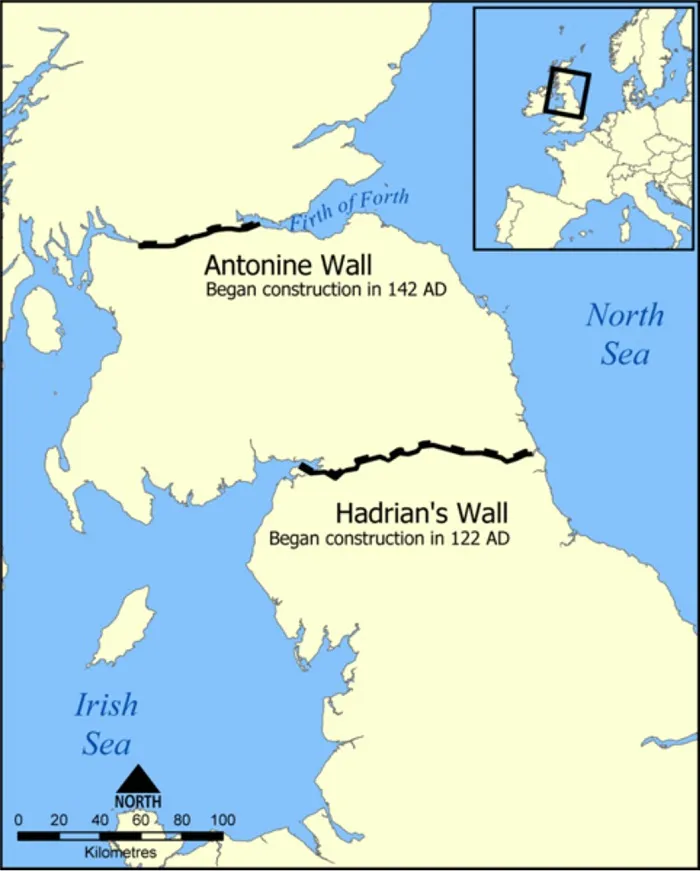 Photo: Hadrian's Wall, via www.british1.co.uk
The economic impact extends beyond mere inconvenience. Cross-border logistics companies report average delivery delays of 23 minutes per cross-border journey, translating to an estimated £847 million annually in lost productivity and increased fuel costs.
A Framework for Geographic Unity
Solutions exist, but they require unprecedented cooperation between Scottish and English geographic authorities. The European Union's INSPIRE directive once provided a framework for harmonising geographic data standards across member states—a model that Brexit Britain has abandoned despite its obvious benefits for internal geographic coherence.
"We need a UK-wide geographic data treaty," argues Professor Helen Morrison, director of the National Centre for Geographic Information Science at University College London. "Just as we maintain unified standards for currency and telecommunications, location data should transcend political boundaries. The technology for seamless geographic integration exists; we simply lack the institutional framework to implement it."
Several pilot programmes offer hope. The Border Geospatial Initiative, launched in 2023, brings together Ordnance Survey, Scottish government data teams, and private sector partners to develop compatible standards for cross-border geographic data exchange. Early results show promising reductions in validation errors and improved route planning accuracy.
The Cost of Continued Division
Without coordinated action, the geographic divide will only deepen as digital infrastructure becomes more sophisticated. Emerging technologies like autonomous vehicles and drone delivery systems depend on seamless, high-precision geographic data that simply doesn't exist across the Anglo-Scottish border.
"We're building tomorrow's economy on yesterday's geographic foundations," warns McKenzie. "Every day we delay geographic harmonisation is another day we're handicapping British competitiveness. The question isn't whether we can afford to fix this—it's whether we can afford not to."
The solution requires political leadership willing to treat geographic data as critical infrastructure rather than administrative afterthought. Until then, the invisible border between Scotland and England will continue extracting a very visible economic toll.