Invisible Terrain: Why Britain's Accessibility Mapping Gap Is a Civil Rights Failure, Not a Technical One

Consider the information that a wheelchair user requires to navigate from a railway station to a hospital appointment in an unfamiliar British city. They need to know not just the distance and direction, but whether the footway surface is smooth enough to traverse, whether dropped kerbs are present at each road crossing, whether the hospital entrance is step-free, whether the lift at the station is operational. This is not an unusual or extravagant set of requirements. It is the minimum spatial information necessary to make an independent journey.
Now consider how much of that information exists in a reliable, accessible, machine-readable form. The answer, across most of Britain, is: very little. And the gap between what is needed and what is available is not primarily a technological problem. The technology to capture, maintain, and publish accessibility data at the required resolution and currency has existed for years. The failure is institutional, political, and — this article argues — ultimately a matter of civil rights.
The Fragmentation Problem
Britain has no single authoritative national dataset for pedestrian accessibility infrastructure. What exists instead is a patchwork: some local authorities maintain reasonably detailed footway inventories within their highway asset management systems; many do not. Some have commissioned accessibility audits of their town centres; the majority have not done so recently, if at all. Organisations such as Wheatley Group in Scotland and various housing associations hold accessibility data for their own estates, but this information is rarely published in a standardised spatial format.
The Ordnance Survey's MasterMap Highways network — the most comprehensive national representation of the pedestrian network — includes footway geometries but has historically carried limited attribute data on surface condition, width, gradient, and kerb type. OS has made progress in enriching this dataset in recent years, and its collaboration with the Department for Transport on the RAMP (Routing and Accessibility for Mobility-impaired People) initiative represents a meaningful step forward. But progress has been incremental, voluntary, and unevenly distributed across the country.
 Photo: Ordnance Survey, via assets.katogroup.eu
The consequence of this fragmentation is that the navigation applications used by disabled people — whether general-purpose tools such as Google Maps or specialist accessibility routing apps — are working from incomplete and frequently inaccurate underlying data. A dropped kerb recorded in a dataset may have been damaged and not yet repaired. A step-free entrance logged three years ago may now be obstructed by a permanent fixture. The map says passable; the pavement says otherwise.
The Human Cost of Inaccurate Data
Disability advocates are emphatic that this is not a matter of inconvenience. For the 14.6 million disabled people in Britain — roughly 22 per cent of the population — inaccurate or absent accessibility mapping translates directly into restricted mobility, social isolation, and enforced dependence on others.
Speaking to CodexGeo, James Rattray, a manual wheelchair user and accessibility consultant based in Glasgow, described the practical reality of relying on digital navigation in a city where accessibility data is inconsistently maintained. "I've learned to treat every route as provisional," he said. "I plan what looks like a viable path, and then I plan a fallback, and sometimes I need a fallback to the fallback. That cognitive load is exhausting. It's time I spend every single day because the data infrastructure that should make this straightforward simply doesn't exist."
Rattray's experience is representative. Research conducted by disability charity Sense in 2022 found that 67 per cent of disabled respondents reported having been unable to complete a planned journey due to accessibility barriers that were not indicated by digital mapping tools. The economic consequences — missed appointments, lost employment opportunities, foregone social participation — are substantial and largely unquantified.
Why the Technical Solutions Exist but Aren't Being Used
The geospatial tools available for capturing and maintaining accessibility data are well-developed. Mobile survey applications such as those developed by Pathwright Analytics and OpenStreetMap-based accessibility projects allow rapid ground-truthing of footway attributes. Computer vision pipelines can extract kerb and surface information from street-level imagery at scale. Crowdsourcing platforms have demonstrated the capacity to generate usable accessibility data in urban areas where volunteer communities are active.
The problem is not the absence of these tools. It is the absence of any mandate to deploy them systematically, any standard that would make the resulting data interoperable, or any funding mechanism to sustain data currency over time.
The Geospatial Commission's Geospatial Strategy 2020–2025 acknowledges the importance of location data for accessibility, and the National Underground Asset Register initiative demonstrates that government is capable of mandating data standards when the political will exists. Yet accessibility data — affecting the daily mobility of millions of citizens — has not attracted equivalent political priority.
Mapping technologist Dr Priya Nair, who has advised several local authorities on accessibility data programmes, is direct about the structural cause. "Utility asset data gets mandated because there's a liability argument — if you don't know where your pipes are, people die and you get sued. Accessibility data doesn't have that same liability driver, even though the human consequences of its absence are just as real. The difference is who bears the cost. In one case it's the asset owner; in the other it's the disabled person. And disabled people don't have the same institutional leverage."
The Case for a Mandatory National Standard
The argument for a mandatory, standardised accessibility data standard is not merely a technical efficiency argument. It is grounded in the obligations that flow from the Equality Act 2010 and the United Nations Convention on the Rights of Persons with Disabilities, to which the United Kingdom is a signatory.
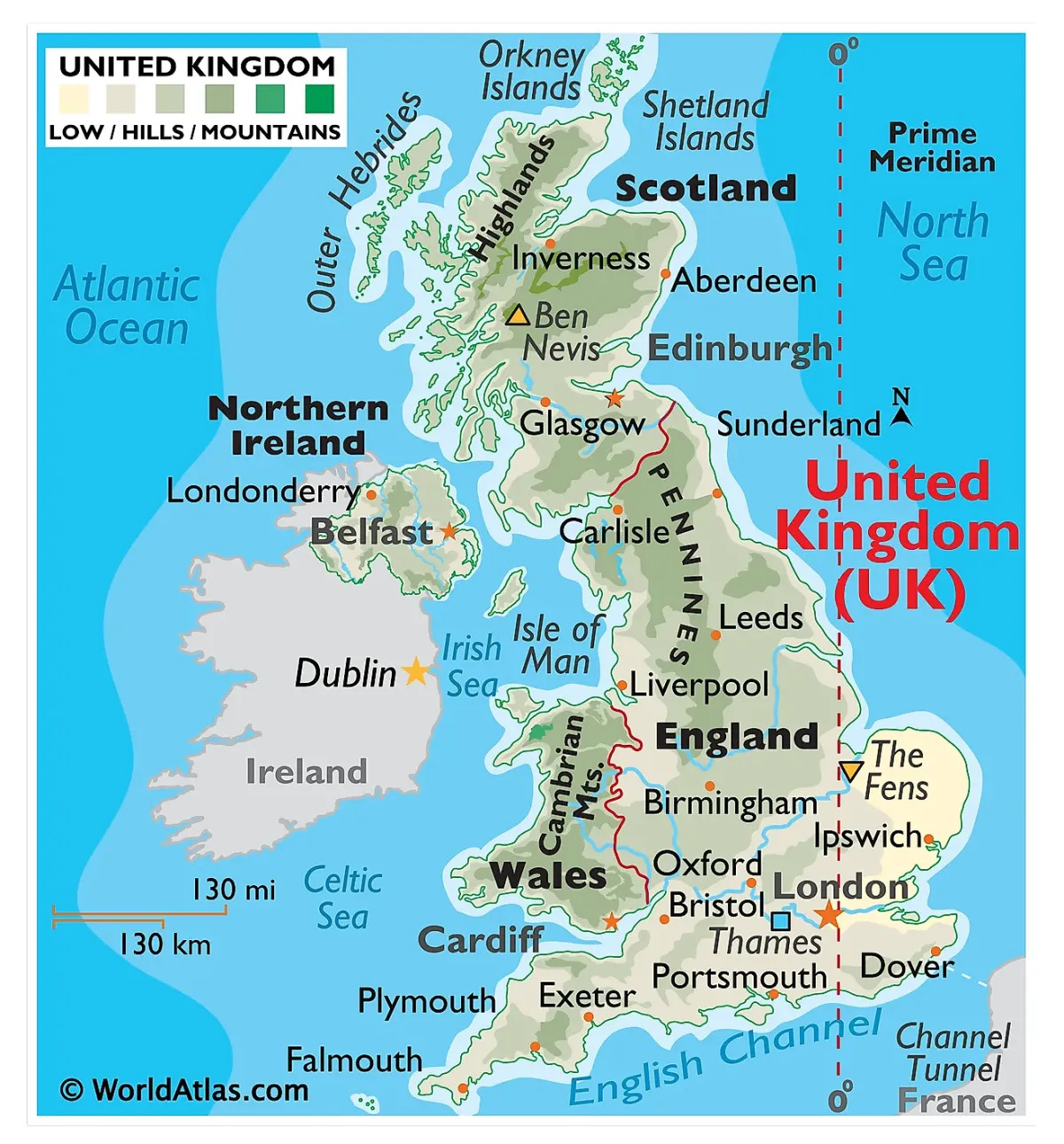 Photo: United Kingdom, via www.worldatlas.com
Article 9 of the UNCRPD requires state parties to ensure that persons with disabilities have access to the physical environment, transportation, and information and communications technologies on an equal basis with others. The systematic absence of accurate accessibility data from Britain's geospatial infrastructure is a concrete impediment to the realisation of this right — one that is, moreover, entirely within the capacity of public authorities to remedy.
A credible national accessibility data standard would need to address several components. First, a minimum dataset specification defining which attributes must be captured for footways, crossings, and public building entrances — surface type, gradient, kerb height, width, obstruction status — and the spatial framework against which they are referenced. Second, a mandatory collection obligation for local highway authorities, with a defined refresh cycle and quality assurance mechanism. Third, an open data publication requirement, ensuring that the data is available to navigation application developers, transport planners, and disabled people themselves without licence restriction or commercial barrier.
The cost of implementing such a standard is not trivial, but it is finite and one-time in character. The cost of not implementing it is paid continuously, in restricted mobility, in foregone opportunity, in the daily erosion of independence for millions of people.
A Question of Political Priority
Britain has demonstrated, when it chooses to, a capacity for ambitious national geospatial programmes. The National LiDAR Programme, the National Underground Asset Register, and the Address Base premium dataset are all examples of government-led initiatives that have created genuinely transformative spatial data infrastructure. The technical and institutional models for a national accessibility dataset already exist. What is absent is the decision to treat the mobility of disabled citizens as a problem of equivalent urgency.
The geospatial community — surveyors, GIS professionals, data architects, and mapping technologists — has a particular responsibility here. The discipline that builds the spatial infrastructure of modern life has the expertise to articulate both the problem and the solution with precision. Whether that expertise is brought to bear on accessibility mapping with the same energy that it has been applied to utility detection or flood risk modelling is, ultimately, a choice about whose geography matters.
The answer, if Britain is serious about the rights it has signed up to, should not be in question.