Counted Out: The Geographic Exclusion of Britain's Gypsy, Roma, and Traveller Communities
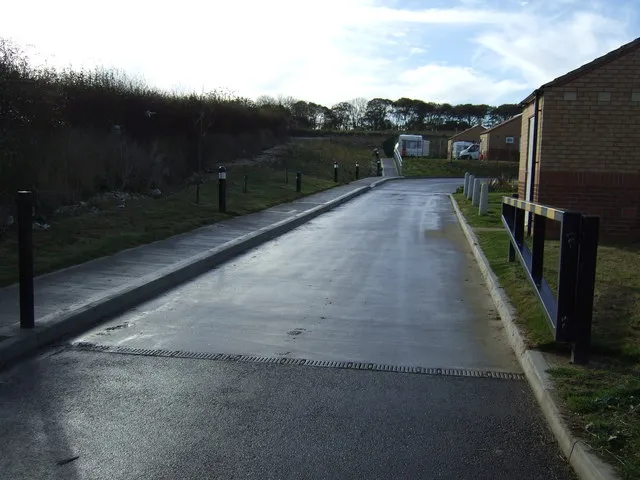
Photo: JThomas , CC BY-SA 2.0, via Wikimedia Commons
Every address on a digital map represents an implicit act of recognition. To be located is, in a meaningful sense, to be acknowledged — by the state, by services, by the infrastructure of modern life. For a substantial portion of Britain's Gypsy, Roma, and Traveller (GRT) population, that recognition has never arrived. They occupy real places, on real land, but those places exist in a geographic limbo that authoritative datasets refuse to enter.
The scale of this absence is difficult to quantify precisely — which is, of course, part of the problem. The 2021 Census recorded approximately 172,000 people in England and Wales who identified as Gypsy or Irish Traveller, Roma, or Showman, though advocacy organisations consistently argue that undercounting is severe, with the true figure potentially several times higher. What is less contested is that a significant proportion of this population lives on sites — both authorised and unauthorised — that carry no address in the Royal Mail Postcode Address File, no entry in Ordnance Survey's AddressBase, and no representation in NHS Digital's patient registration geography.
 Photo: Ordnance Survey, via demonslayer-hinokami.sega.com
 Photo: Royal Mail Postcode Address File, via 1.bp.blogspot.com
The Architecture of Absence
To understand how this exclusion is constructed, it is necessary to appreciate how British addressing works in practice. A property acquires a formal address through a local authority street naming and numbering process, which then propagates into the PAF, AddressBase, and downstream systems. For a conventional dwelling — a house, a flat, a converted commercial unit — this process is largely automatic, triggered by planning consent and building completion.
For a Traveller site, the pathway is far less certain. Many authorised sites — those with formal planning permission from a local council — have never been assigned individual plot addresses, receiving instead a single site-level designation that obscures the distinct households within. Unauthorised encampments, by definition, fall entirely outside any formal addressing process. The result is that residents of these sites are, from the perspective of every system that relies on geographic identifiers, essentially non-existent.
The consequences ramify outward from that single point of absence in ways that touch almost every domain of public life.
Healthcare: The Registration Barrier
GP registration in England requires a registered address that can be verified against NHS Digital's Address Management Service. Where a patient cannot supply an address that resolves to a recognised geographic record, the registration process frequently stalls. Practice managers, often unaware of alternative pathways available under NHS England guidance, default to rejecting registrations from addresses that their systems cannot validate.
The downstream effects are substantial. Missed childhood vaccination schedules, delayed diagnosis of chronic conditions, and absent antenatal care are among the health outcomes disproportionately affecting GRT communities — outcomes that geographic invisibility actively worsens. NHS England's own health equity guidance acknowledges the registration barrier, but the gap between policy acknowledgement and front-line implementation remains considerable.
For mobile communities — those who move between sites seasonally or in response to enforcement action — even a successful registration may become functionally useless within weeks, as correspondence, referral letters, and prescription notifications are dispatched to an address the patient no longer occupies.
Electoral Participation and Civic Invisibility
Electoral registration presents a parallel challenge. The Individual Electoral Registration system requires applicants to supply a residential address that can be verified against a local authority's address database. Where no such address exists in the authoritative record, the application cannot be processed through standard channels, and many applicants — unaware of the discretionary powers available to Electoral Registration Officers — simply do not pursue the matter further.
The political consequence is a community that is systematically underrepresented in the democratic process, not through any legal exclusion but through the quiet, technical failure of geographic infrastructure to acknowledge their existence.
Emergency Services and the Cost of Being Unfound
Perhaps the most viscerally urgent consequence of geographic absence is its effect on emergency response. When a 999 call is placed from a site that carries no address in the emergency services' mapping systems, the call handler faces an immediate problem: they cannot dispatch a resource to a location they cannot resolve. The caller may describe their surroundings in terms that are meaningful to them — a field entrance, a particular road junction, a landmark — but which do not map onto any record in the Computer Aided Despatch system.
Britain's emergency services have made considerable progress in integrating what3words into their call-handling workflows, and the technology offers genuine utility in this context. A three-word address can locate a caller within a three-metre square regardless of whether any formal address exists. Several forces and ambulance trusts now actively promote what3words to communities in rural and peri-urban locations, and some GRT community organisations have begun distributing the application specifically in response to emergency access failures.
However, what3words is a supplementary tool, not a systemic remedy. It places the burden of navigating geographic invisibility on the individual in crisis rather than resolving the underlying absence in authoritative data.
The Ethics of Mapping Reluctance
Any honest examination of this issue must engage with a dimension that purely technical solutions cannot address: the historical relationship between GRT communities and official record-keeping is one defined by surveillance, persecution, and harm. The systematic registration of Romani people by European states during the twentieth century — including in Britain, where the Vagrancy Acts criminalised nomadic life for generations — means that institutional data collection is not a neutral proposition for these communities. Distrust of official mapping and registration is not irrational; it is the accumulated wisdom of communities that have learned, across generations, that visibility to the state has frequently preceded targeting by it.
This context imposes an ethical obligation on organisations seeking to improve geographic representation of GRT communities. Data collection must be community-led, transparently governed, and subject to genuine consent — not merely the technical consent of a checkbox, but the informed, deliberate consent of communities that understand what they are agreeing to and retain meaningful control over how their data is used.
Several local authorities have begun working with GRT liaison officers and community representatives to develop site-level addressing schemes that provide the minimum geographic identifiers necessary for service delivery without creating surveillance infrastructure. These initiatives are fragmented and underfunded, but they represent a model worth scaling.
Toward a Flexible Addressing Standard
Ordnance Survey's Unique Property Reference Number system is, in principle, sufficiently flexible to accommodate non-standard dwelling types — including mobile homes, caravans, and plots within managed sites. The technical barriers to assigning UPRNs to Traveller site plots are modest; the political and administrative barriers are considerably greater.
What is required is a national framework that establishes a clear, low-friction pathway for local authorities to assign site-level and plot-level geographic identifiers to GRT sites, with a presumption in favour of inclusion rather than a default of exclusion. Such a framework should be developed in genuine partnership with community representatives, should include provisions for data governance that reflect community concerns, and should be accompanied by the training and resources necessary for front-line housing, health, and emergency service staff to act on the resulting data.
Britain has a Geospatial Commission whose stated purpose is to maximise the value of location data for the public good. The geographic exclusion of some of the country's most marginalised communities is a direct challenge to that mandate — one that demands a response more substantial than the current silence.